
Homemade French Croissants

Discover how to make homemade French croissants at home with this simple recipe. With step-by-step instructions to make buttery, and fluffy croissants from scratch. Your kitchen has a delicious taste and smell of freshly baked croissants afterward. And once you have tasted these croissants, I am sure you will make them again and again.
Ingredients
- 1¼ teaspoon yeast instant
- 3 tablespoons water lukewarm, 99 °F / 37 °C
- 1 teaspoon sugar
- 2 teaspoons sugar
- 1½ teaspoon salt
- ½ cup whole milk
- 1¾ cup all-purpose flour
- 2 tablespoons vegetable oil
- 1 stick butter cold, unsalted butter
- 1 egg for egg wash, size S
Ingredients you need per step are listed below the step in Italic
Instructions
- Mix the yeast, warm water, and first teaspoon of sugar in a small bowl.1¼ teaspoon yeast, 3 tablespoons water, 1 teaspoon sugar
- Leave aside for the yeast and sugar to dissolve and the yeast to foam up a little.
- Heat the milk until tepid (either in the microwave or a saucepan), and dissolve in the salt and sugar.2 teaspoons sugar, ½ cup whole milk, 1½ teaspoon salt
- Place the flour in a large bowl. Add the oil, yeast mixture, and milk mixture to the flour.1¾ cup all-purpose flour
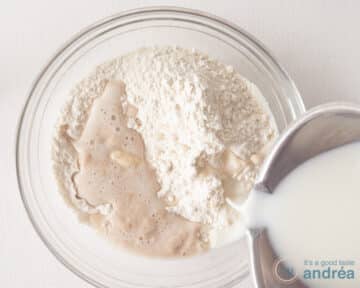
- Mix all the ingredients together using the rubber spatula, just until all the flour is incorporated.

- Turn the dough out onto a floured surface, and let it rest a minute while you wash out the bowl.

- Knead the dough only eight to ten times.
- Take the dough and smash it on the surface (lots of fun if you are mad at someone) and removing it from the counter using the pastry scraper.
- Place the dough back in the bowl, and cover the bowl with plastic foil.

- Leave the bowl at approximately 75 °F/24 °C for three hours, or until the dough has tripled. After the dough has tripled in size, remove it gently from the bowl, pulling it away from the sides of the bowl with your fingertips.

- Place the dough on a lightly floured board or countertop, and use your hands to press it out into a rectangle, about 8 x 12 inch (20 x 30 cm). Fold the dough into thirds (just like a letter). Fold the bottom ⅓ part up.

- And fold the top third down.

- Place the dough letter back in the bowl, and cover the bowl with plastic foil. Leave the dough to rise for another 1½ hours, or until it has doubled in size. This second rise can be done overnight in the fridge.

- Place the double-risen dough onto a plate and cover tightly with plastic wrap. Place the plate in the fridge while you prepare the butter.
- Place the block of chilled butter on a chopping board. Using the rolling pin, beat the butter down a little, till it is quite flat. Use the heel of your hand to continue to spread the butter until it is smooth. You want the butter to stay cool, but spread easily.1 stick butter

- Remove the dough from the fridge and place it on a lightly floured board or counter.
- Let it rest for a minute or two.
- Spread the dough using your hands into a rectangle about 14 x 8 inch (35 x 20 cm).
- Remove the butter from the board, and place it on the top half of the dough rectangle. Spread the butter all across the top two-thirds of the dough rectangle, but keep it ¼ inch (6 mm) across from all the edges.

- Fold the top third of the dough down, and the bottom third of the dough up.

- Turn the dough package 90 degrees, so that the top flap is to your right (Roll out the dough package gently, so you don’t push the butter out of the dough) until it is again about 14 x 8 inches (35 x 20 cm).

- Again, fold the top third down and the bottom third up. Wrap the dough package in plastic wrap, and place it in the fridge for 2 hours.

- After two hours have passed, take the dough out of the fridge and place it again on the lightly floured board or counter. Tap the dough with the rolling pin, to deflate it a little.
- Let the dough rest for 8 to 10 minutes. Roll the dough package until it's 14 x 8 inches (35 x 20 cm). Fold in three.
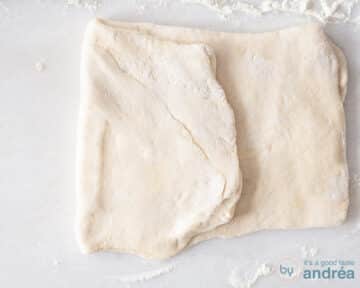
- Turn 90 degrees, and roll out again until it's 14 x 8 inches (35 x 20 cm). Fold in three for the last time, wrap in plastic, and return the dough package to the fridge for two more hours (or overnight, with something heavy on top to stop it from rising).

- It’s now time to cut the dough and shape the croissants.
- First, lightly butter your baking sheet so that it is ready.
- Take the dough out of the fridge and let it rest for ten minutes on the lightly floured board.
- Roll the dough out into a 20 x 5 inches (50 x 12½ cm) rectangle.

- Cut the dough into three rectangles of 10 x 5 inches (25 x 12½ cm). Place two of the rectangles in the fridge, to keep the butter cold. Roll the third rectangle out until it is 15 x 5 inches (37 ½ x 12 ½ cm).
- Cut the rectangle into three squares of 5 x 5 inches (12 ½ x 12½ cm). Cut each squares diagonally, creating triangles.

- Take a triangle and place the dough so that a straight line is formed at the bottom and the point is in the middle at the top. Roll up from the wide side at the bottom, upwards. Shape the croissant into a half moon and place on the baking tray.
- Place the unbaked croissant on the baking sheet. Repeat the process with the remaining squares of dough, creating 12 croissants in total.
- Leave the tray of croissants, covered lightly with plastic wrap, to rise for 1 hour. Preheat the oven to very hot
 465 °F or
  430 °F.
 - Mix the egg with a teaspoon of water and brush the egg on top of the croissants.1 egg

- Put the croissants in the oven for 12-15 minutes, until the tops brown nicely.
- Take the croissants out of the oven and let them cool down on a rack for 10 minutes before serving. Eat them cool or nice and warm.
NOTES
1. Yeast: This recipe uses 4 grams (1 ¼ teaspoons) of instant yeast. If you prefer to use fresh yeast, you need 8 grams. If you use dry yeast, you require 4 grams. Please note: with both fresh yeast and dry yeast, you must first dissolve the yeast in lukewarm milk.
2. Variations
- Chocolate croissants: Spread chocolate chips over the croissant dough before rolling it up.
- Almond croissants: After brushing with egg, sprinkle some almond shavings on the croissant for a crunchy breakfast.
- Mini croissants: Cut each triangle in half and roll up.
- Sweet croissants: Instead of the beaten egg, you can heat some jam and brush the bread with it.
- Freezer (unbaked croissants): Freeze the croissants in step 36. Place them on a baking sheet, let them freeze, then remove them from the baking sheet and place them in a freezer bag. You can store them this way for up to a month. The croissants do not need to be defrosted and can be baked directly from the freezer for 17-20 minutes.
- Room temperature: You can store the baked croissants one day in a paper bag.
- Freezer (baked croissants): Pack the rolls in a freezer bag or box. They will keep this way for up to a month. Allow to thaw at room temperature.
- Reheat (baked croissants): Heat the croissants for a few minutes in a preheated oven at 300 °F (150 °C) or use an Air fryer for this.
Nutrition
Calories: 172kcal | Carbohydrates: 16g | Protein: 3g | Fat: 11g | Saturated Fat: 6g | Polyunsaturated Fat: 2g | Monounsaturated Fat: 3g | Trans Fat: 0.3g | Cholesterol: 35mg | Sodium: 365mg | Fiber: 1g | Sugar: 2g | Vitamin A: 272IU | Vitamin C: 0.001mg | Iron: 1mg
Have you tried this recipe?Show @byAndreaJanssen or tag #byAndreajanssen
