



If there's one person in this house who reaches for soup over anything else and always for lunch if I get to choose, it's me.
I've made this Tom Kha Goong more times than I can count, tested it with both vegetable stock and chicken stock, and adjusted the curry paste up and down over the years to make sure it still worked for the whole family back when the kids were younger.
Chicken stock wins on depth every time, but vegetable stock holds its own if that's what you've got. It's a soup that's endlessly easy to vary, and every version still comes out packed with flavor from all those spices.

Jump to:
Tom Yum vs. Tom Kha Goong
Thai cuisine has two different types of soup: Tom Yum and Tom Kha. But are they really that different?
The basis of both soups is the same. A stock that you make with the same spices and that is fragrant and has a lot of taste.
The difference is that Tom Yum does not use red curry paste and when served as a creamy soup it's mixed with unsweetened condensed milk.
Red curry paste is added to Tom Kha and the creamy taste is achieved by mixing the stock with coconut milk. Just like in this recipe.
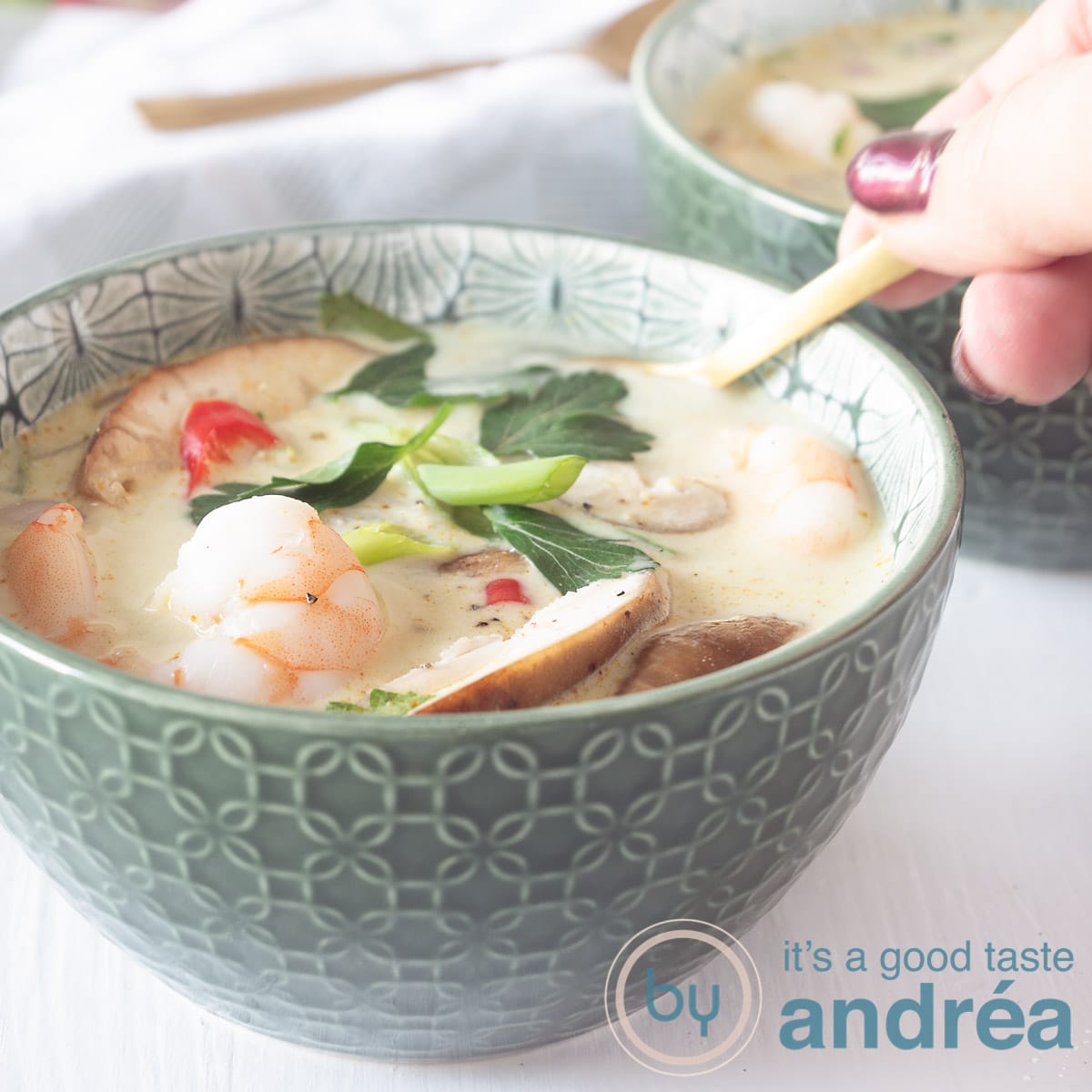
How to prepare Thai Coconut Soup with Shrimp
For the preparation of this Tom Kha Goong Soup you need the following ingredients (you can find the correct amounts in the recipe card at the bottom of the blog):

- Stock - I've tested this with both vegetable stock and chicken stock, vegetable works fine if you're keeping it vegetarian, but chicken stock gives it a noticeably deeper flavor, which is what I reach for by default.
- Shrimp and Shiitake - Shrimp and Shiitake are the proteins used in this soup. You can replace the shrimp with the chicken. If you want to go vegetarian, only add shiitake.
- Coconut milk - To make the soup creamy coconut milk is added.
- Red curry paste - I've varied this amount quite a bit over the years, especially when my kids were younger and I wanted a version the whole family could eat together, starting at 1 teaspoon keeps it mild enough for kids while the soup still tastes like something.
- Lemongrass - To give a slight lemon flavor to the soup.
- Red pepper - To bring a bit of spice to this soup. You can add some more if you like a spicy soup.
- Ginger and Shallot - The basis of this soup.
- Fish sauce - Gives a salty, slightly fish flavor to this soup.
What is Galangal and Do You Really Need It?
The "kha" in Tom Kha actually means galangal, it's the ingredient that gives this soup its name, and it looks like ginger's sharper, more citrusy cousin. If you can find it fresh at an Asian grocer, use it: it brings a peppery, almost pine-like note that ginger doesn't fully replicate.
That said, this recipe is written with ginger on purpose, because it's what's realistically sitting in most home kitchens and supermarkets, and the difference is smaller than people expect once the coconut milk and curry paste are in the mix. If you do have galangal on hand, swap it in at the same quantity as the ginger.
Kaffir lime leaves are the other "authentic" ingredient you'll see in traditional versions. I leave them out here because they're genuinely hard to find outside specialty stores, the lime juice and lemongrass in this recipe cover that citrus note well enough that you won't miss them.
How to cook Thai Tom Kha Goong Soup
A recipe with extensive steps, the right amount of ingredients, and which you can also easily print can be found at the bottom of the blog.

- Make the stock base by adding the stock, ginger, red curry paste, fish sauce and lemon grass. Let it simmer 10 minutes.
- Add coconut milk, shallot, shiitake and pepper and let it simmer for 5 minutes.
- Add the shrimp and cook until done.
- Remove the lemon grass. Put some lime juice and parsley in the pot and serve.
Why the soup doesn't split
Coconut milk is an emulsion, tiny fat droplets suspended in water and hard, rolling boils are what break that emulsion apart, leaving you with a greasy, separated soup instead of a silky one.
That's why the coconut milk goes in after the initial 10-minute stock simmer, and why the heat comes down to a gentle simmer from that point on. Keep it low once the coconut milk is in, and the soup stays creamy instead of splitting.
What to Serve With Tom Kha Goong
This is a full meal on its own, but a small scoop of steamed jasmine rice on the side (or right in the bowl) rounds it out if you want something more filling. It also keeps well enough to pack for lunch the next day, see the storage notes below.
Frequently Asked Questions
- Is Tom Kha Goong very spicy? As written, it's mild-to-medium, the 2 teaspoons of red curry paste is a family-friendly amount. If you like more heat, increase it to 1 tablespoon, or add extra sliced red chili at the end.
- Can I use frozen shrimp? Yes, thaw them first (cold water works fast), pat them dry, and add them at the same point in the recipe. Wet shrimp will water down your broth.
- Can I make this ahead of time? Make the broth base a day ahead and refrigerate it; add the shiitake and shrimp only when you reheat, so they don't overcook. See the storage notes in the recipe card for freezing instructions.
- No fish sauce, what can I use instead? Soy sauce is the closest swap for saltiness and umami, though it won't have quite the same depth. Use it in the same quantity.

📖 Recipe
RECIPE CARD

Recipe Help
Two easy tools to make cooking even easier. Cooking mode keeps the screen on. The easy-step recipe displays the recipe step by step, including the ingredients needed. And you can adjust servings easily
Ingredients
- 3 cups chicken stock, fresh or from a cube
- 1 inch fresh ginger, fresh, grated
- 2 teaspoons red curry paste, 1 teaspoon for a milder soup
- 2 tablespoons fish sauce
- 1 lemongrass
- 2 cups coconut milk
- 1 shallot, finely chopped
- 6 oz. shiitake, cut into strips
- 1 red chili pepper, cut into strips
- 5 oz. shrimp
- 1 tablespoon lime juice
- ½ oz. Fresh Parsley, finely chopped
- 1 spring onion, cut into strips
All my recipes are written both in Metric (gram / ml) and US Customary (cups / pounds). Here you can select which type of amount you would like to see.
Instructions
- Pour the chicken stock into a large saucepan and add the ginger, red curry paste, and fish sauce.3 cups chicken stock, 1 inch fresh ginger, 2 teaspoons red curry paste, 2 tablespoons fish sauce
- Crush the lemongrass and add that to the pan as well. Bring to boil.1 lemongrass
- Lower the heat and let it simmer for 10 minutes.
- Add the coconut milk, shallot, shiitake, and pepper to the stock.2 cups coconut milk, 1 shallot, 6 oz. shiitake, 1 red chili pepper
- Let the soup simmer for 5 minutes.
- Put the shrimp in the pan. Simmer for 2 minutes if they are already cooked and 5 minutes for raw (grey) shrimp.5 oz. shrimp
- Turn off the heat and remove the lemongrass.
- Season with lime juice and parsley.1 tablespoon lime juice, ½ oz. Fresh Parsley
- Pour into the soup bowls and garnish with strips of spring onion1 spring onion
Notes
- Refrigerator: Leftover soup can be cooled quickly and kept covered in the refrigerator for up to 2 days.
- Freezing: For best results, freeze the soup before the shiitake and shrimp have been added. It can then be kept for at least two months.
- Thaw: in the refrigerator and heat until almost boiling. Add the shiitake and simmer for 5 minutes. Then put the shrimp into the soup pot.
- When you have already added everything, you can also freeze this soup. Only the texture of the shiitake and shrimp changes and that is less tasty.
The nutritional value is shown per person.
Nutrition




Leave a Reply